
SERVICE AREA / MESA, AZ
Roofing in Mesa
means roofs built
in the seventies and eighties boom.
Mesa more than quadrupled between 1970 and 1990. That is when more of today’s housing went up than in any other period, and it is why so much of the city is now on its second or third roof rather than its first.
A USEFUL FIRST QUESTION
“Is this the original roof, or has someone already replaced it once?”
01 / WHEN MESA WAS BUILT
Sixty thousand
to nearly three
hundred thousand.
Mesa incorporated in 1883, but much of the Mesa people live in today was built across two decades.
| 1960 | 33,772 |
|---|---|
| 1970 | 63,049 |
| 1980 | 152,453 |
| 1990 | 288,091 |
| 2020 | 504,258 |
The 1970s alone added nearly 90,000 people. Housing built in that decade is now between 47 and 56 years old.
A roof laid in 1978 has been replaced by now, or it should have been. The useful question in Mesa is rarely whether the roof is old. It is what the last replacement actually consisted of, and who did it.
02 / ACROSS THE CITY
Not every
part of Mesa
is the same age.
01
West Mesa
West of Center Street
The older half. Mostly 1970s and 1980s stock, with postwar and 1960s housing closer to downtown, much of the older part low-slope and re-roofed more than once. Layer history matters here more than build date.
02
The 1970s and 1980s tracts
Dobson Ranch, the Fiesta district and the corridors around them
The core of Mesa housing. Originally shingle and built-up roofs. Many were converted to tile later, and conversions are where the detailing gets interesting.
03
East Mesa
Superstition Springs, Las Sendas and the eastern growth
Newer tile from the 1990s and 2000s. The same story as the rest of the valley: sound tile over underlayment that has reached the end of its life.
04
Manufactured and park housing
Scattered across the city, concentrated in central and east Mesa
Mesa has a substantial amount of manufactured housing. These have entirely different roof systems, usually low-slope metal or membrane, and they are assessed and repaired on different terms.
03 / WHAT THE ROOFS ARE MADE OF
What you
tend to find
in Mesa.
Tile, mostly retrofitted rather than original
A great deal of Mesa tile went on after the house was built. That matters: a retrofit has to deal with a structure designed for a lighter roof and with flashing details that were not planned for tile.
Asphalt shingle, the original default
What most 1970s and 1980s Mesa housing was built with. Where shingle is still present it has been replaced at least once, and the quality of that replacement is the variable.
Built-up and foam on the low-slope sections
Carports, patio covers and additions from this era are commonly low-slope. Foam over an old built-up roof is a frequent find, and it performs well when it has been recoated on schedule.
04 / WHAT SHOWS UP HERE
The patterns
worth knowing
about.
01
Conversions done cheaply.
A shingle roof converted to tile without addressing the underlayment or the flashing leaves a heavy roof over an old waterproofing layer. This turns up in Mesa more than most places, and it is not always visible from the ground.
02
Low-slope sections on pitched houses.
Carports, patio covers and added rooms from this era are often low-slope tied into a pitched roof. That transition is a specific detail, and it is frequently where the leak actually is.
03
Repairs with no record.
On a house that has changed hands twice, the current owner usually has no idea what was done in 1998 or by whom. Opening up a small area answers more than another opinion does.
05 / WHAT CHANGES THE PRICE
Why two quotes
can differ by
thousands.
01
Whether the deck has to come off
If previous work left layers in place, nobody has seen the deck in decades. A scope that tears off tells you what you are dealing with; a scope that goes over the top is cheaper and keeps the unknown.
02
Retrofitted tile and its structure
Where tile was added to a house built for shingle, the load and the detailing both need checking. That occasionally changes the work substantially, and it is better established early than discovered mid-job.
03
How many roof planes there are
Mesa tract housing is often simple, which keeps cost down. Houses that have had addition after addition are not simple anymore, and every added junction is labor and a potential failure point.
07 / MESA QUESTIONS
Common ones.
The houses on my street all look the same. Do they have the same roof problems?
Often yes, and that is genuinely useful. Tract housing built in the same year to the same specification tends to fail the same way at the same time. If three neighbors have had work done, that is information about your roof.
My Mesa house has tile but was built in 1979. Is that original?
Almost certainly not. Concrete tile was not the default on 1970s Mesa tract housing. If the house is from that era and has tile, it was probably converted later, and how that conversion was detailed matters more than the tile itself.
Is a low-slope roof section worse than a pitched one?
Not worse, but different, and it needs a different system. Low-slope roofs are maintained rather than finished. Where a low-slope section meets a pitched roof is one of the more demanding details on a house.
How do I find out what was done to my roof previously?
Permit records sometimes help and previous owners occasionally do, but the reliable method is to look. A limited exploratory opening tells you what the layers actually are, rather than what someone assumed.
Can you work on a manufactured home?
Those are a different roof system and they are assessed on their own terms rather than as a smaller version of a house roof. Tell us what the home is and we will tell you honestly whether it is work we should be doing.
Is it worth repairing a 1980s roof or replacing it?
It depends entirely on what the last replacement was and how it has held up, not on the age of the house. A well-detailed roof from 2005 on a 1982 house has years in it. A poorly detailed one from 2015 may not.
ATLAS JOB PHOTOS
Recent work in Mesa.
Photographed on the job. Addresses are never shown. All recent work →
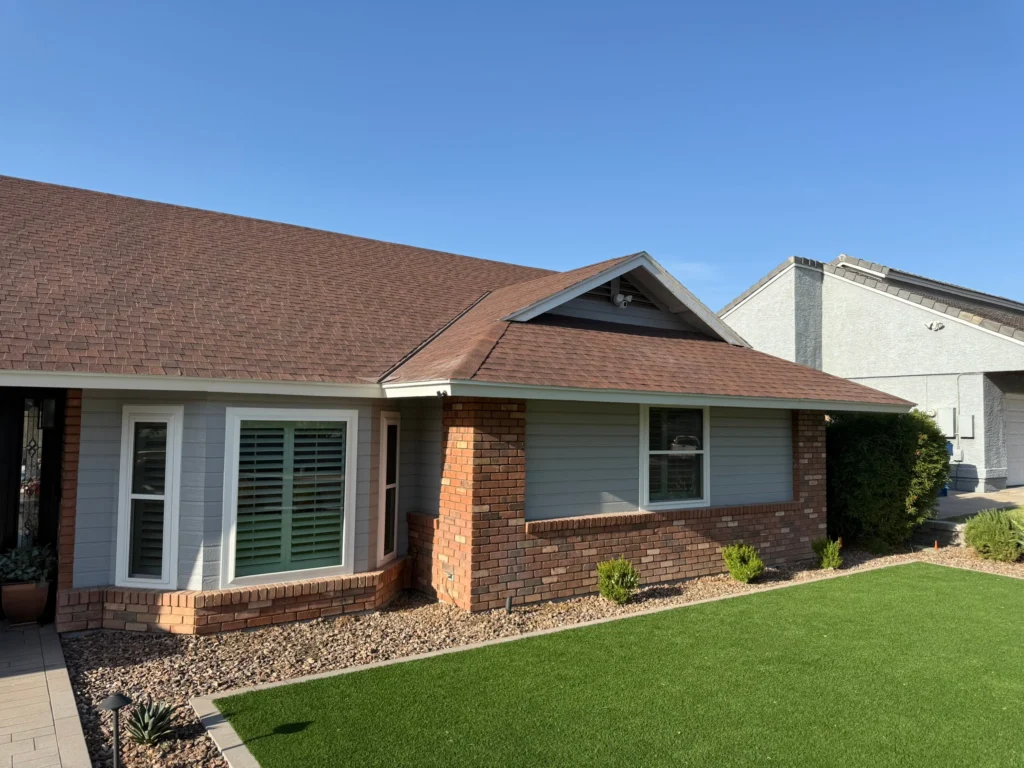
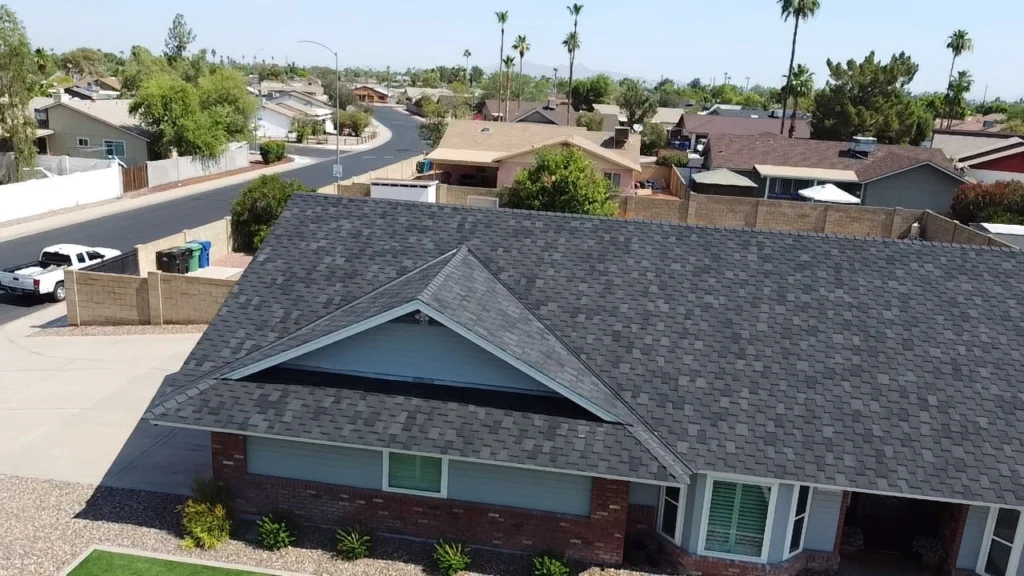
Shingle roof replacement
What was wrong. Storm damage to the shingle roof.
What we did. Replaced the shingle roof.
Roofing in Mesa?
Original roof, or a replacement? And if it was replaced, how well? A free inspection is the quickest way to find out.